
Online roulette RNG is a certified software algorithm that picks the winning pocket before the ball animation plays, and at a Gambling Commission-licensed site it is tested by an independent test house so neither the operator nor the player can influence a spin. The same checks cover the RNG (random number generator) behind every one of the casino games in the lobby. Even the free demo at a licensed casino sits behind an age check, so the 18+ rule applies before a single play-money chip goes down.
Most players arrive here after a run of losing spins and a sense that the software is against them. Three things settle that doubt: a licence, a test-house certificate and a published house edge. The house edge is the share of all stakes a game keeps over the long run. It comes from the gap between the true odds of a bet and what it pays.
We give every figure with its wheel type and date, because online casinos sell several wheels under one name. Everything that follows applies to RNG games at UK-licensed sites only, so the first check is always the licence, not the lobby.
How Online Roulette RNG Picks Every Number
By the time the ball appears to leave the rim, the winning pocket has already been chosen. Online roulette RNG settles every spin the instant you press the button. The wheel you then watch is a drawing of a decision already made, and nothing in the animation can change the number.
The generator code is locked away from both sides: neither the operator nor the player can read it or alter it, so the only thing a spin can be is random.
What the player sees and what the software does are two separate events. The sequence below runs in the same order in every certified game, whatever the provider.
- Bet placed: your chips sit on the layout and the stake is held from your balance.
- Value captured: the generator’s current number is frozen the moment the spin is requested.
- Value mapped: that number is converted into a pocket on the wheel in play.
- Animation plays: the ball and wheel are drawn to land on the pocket already chosen.
- Stake settled: winning bets are paid at the paytable rate and losing chips are cleared.
Pseudo-Random and True Random Generators
A pseudo-random generator is the standard random number generator in roulette. It runs an algorithm from a starting seed value and produces a sequence with no discernible pattern. The seed is never exposed, which is why nobody can reproduce the stream.
A true random generator draws on a physical process such as atmospheric noise. Hardware limits make it rare in roulette games, which need thousands of results an hour across many tables. Both kinds of random number generators count as RNGs for certification, and both face the same tests.
A certified generator cycles through numbers continuously, typically thousands of times a second. The value captured at the moment the spin is requested becomes the result. Press the button a millisecond later and you get a different number, which is why timing a click is pointless.
From Number to Wheel Animation
The generator’s output is mapped to the pockets of the wheel in play: 0-36 on a single-zero wheel, or 0, 00 and 1-36 on a double-zero wheel. Each pocket gets an equal slice of the generator’s range. The ball and wheel animation is then drawn to match a result that already exists.
A few RNG titles add extra pockets or multipliers, so the mapping is not always 0-36. The paytable, not the animation, tells you what wheel you are on. A game that shows 37 pockets on screen can still be settling on a larger layout behind the graphics.
That exception changes the maths of every bet on the title, and most guides skip it. If a game’s help screen does not name its generator certification and its pocket layout, treat it as a game we would not stake on.
Why Licensed Casinos Do Not Need to Rig Roulette
A licensed casino makes its money from the gap between true odds and payouts, and that gap is already written into every roulette paytable. The house edge gives the operator a guaranteed long-run margin on every bet, while every player keeps a fair chance on each spin. Fixing a game adds risk and no revenue.
Players who call roulette rigged usually mean one of four things, and each is a different claim.
- Loss rate above the advertised one: the game keeps more of stakes than its published edge.
- Results shown differ from the output: the screen displays a number the random number generator did not produce.
- No genuine generator at all: a script fakes randomness with a fixed or weighted list.
- Results manipulated so the player loses: the number generator is steered against a specific account.
None of the four earns licensed casinos anything they would not earn the honest way. A game players distrust earns nothing, because the stakes stop. The edge only works while people keep betting, and they only keep betting while they trust the wheel.
The Gambling Commission and the Malta Gaming Authority audit both operators and game providers, and either can suspend a licence. For a provider, one tampered title would cost every contract it holds. A generator is cheaper to run straight than to fix.
The real risk for UK players is not a fixed game at a licensed site. It is a site with no licence, where none of these incentives apply and no regulator can act. Treat any site that will not show its licence number as a site where the house edge is whatever it wants it to be.
How the Gambling Commission Tests Games and RNGs
A roulette game reaches a UK lobby only after an independent test house has signed off its generator and its maths, and it stays there only while every later change is logged and tested. The Gambling Commission does not run the tests itself. It sets the standard, licenses the operators and checks that the certification trail exists.
Fairness is enforced, not promised. Random number generators are the one component in a casino game that a player can never inspect, so the regulator makes someone independent inspect them instead.
External Test Houses and the Technical Standards
The rulebook is the Remote Gambling and Software Technical Standards (RTS), which cover technical standards and security requirements. UK-licensed remote gambling and gambling software operators must comply with them, and the current version was updated on 30 September 2026. Every RNG in a UK lobby is measured against that document.
An external test house certifies two things. The first is the random number stream itself, checked for distribution and independence over a very long run of draws. The second is the game maths: that a 35:1 straight-up pays 35:1 and that the published return matches the layout.
Results from that assessment go to the regulator with the game’s version number. The certificate belongs to that version, not to the title.
Change Control After a Game Goes Live
Development and testing environments should be logically separate. Testing should be performed by staff separate from those who developed the product, although iterative testing within the same team may be used in an agile environment. The developer who wrote the code is not the person who signs it off.
Major game or RNG changes require confirmation of an adequate external test-house assessment. Minor changes require confirmation that they have been internally tested and documented. Game and critical-system changes need a documented change-management plan with adequate testing, change controls and authorisations before release to the operational environment.
A game you played last year may have been through several minor updates since. Each one was logged and tested, but none was re-certified externally, and that is normal and permitted. Only a change to the generator or the maths sends the game back to the test house.
A regulator can compare the game code running on a site with the code registered by the provider. On a mismatch it can remove the game from the lobby. RNGs and games carry that registered fingerprint for as long as they are live. The test certificate covers the version registered with the regulator, which is why a game pulled from a UK lobby often reappears days later with a new version number.
Five Checks Before You Trust a Roulette Site
Our first check on any new site is the licence number, searched on the Gambling Commission’s public register rather than read off the footer. The whole routine takes five minutes and settles whether a casino’s RNG is certified. Players who skip it are trusting a logo.
- Search the licence number: type it into the Gambling Commission register and confirm the trading name matches the site.
- Find the test-house seal: eCOGRA, iTech Labs and GLI are the labs whose seals appear on certified games.
- Confirm the provider is named: the lobby should show who built the roulette title, not just the operator’s brand.
- Open the help screen: licensed sites publish the RTP or house edge in each game’s information panel.
- Compare a long run: over thousands of spins, results should sit close to the published probabilities.
A game that consistently defies its published odds is a warning sign, and so is a site that hides them. Vague licensing details, poor reviews and unrealistic promotions are the usual red flags at online casinos. A bonus that looks too big to be true is a sign that nobody is checking the terms.
One check most guides skip: a site that shows a Curacao licence and a UK flag is not licensed for UK players, whatever its homepage says. The flag is a graphic. Only a Gambling Commission entry puts certified random number generators behind the game.
Most roulette rigged complaints we see involve casinos that fail step one. There is no way for a licensed operator to hide a suspended licence from the register. Run the five checks once per site, not once per game, because the licence covers every title in the lobby.
RNG Roulette vs Live Dealer Roulette
For most UK players we would start with RNG roulette, because the minimum stakes are lower and the session runs at your own pace; live dealer roulette wins when you want higher limits and a shared table. The two formats produce the result differently and feel different. That is the whole of the difference.
In live dealer roulette a human dealer in a studio spins a physical wheel. The ball drops, a camera catches the pocket, and the result is streamed in real time while you bet through the on-screen interface. RNG roulette runs automatically, with no dealer pause between spins.
| Feature | RNG roulette | Live dealer roulette | Which suits whom |
|---|---|---|---|
| How the result is produced | Certified software picks the pocket | Physical wheel and ball, streamed | Neither: the odds match |
| Pace | Spin on demand, no dealer pause | Dealer-led, bets close before each spin | RNG for short sessions |
| Typical minimum stake | About 10p-20p | About 50p-£1 | RNG for small bankrolls |
| Maximum limits | Lower table maximums | Higher maximums | Live for high stakes |
| Availability | Any time, no seat limit | Open tables at the studio’s schedule | RNG for late or short visits |
| Variants | Multi-wheel and lightning-style multiplier games | Standard wheel with a dealer | RNG for variety |
| Social features | None | Chat with the dealer and other players | Live for company |
Online roulette odds do not move with the format. The house edge for the same wheel type is identical in both, so a red bet on a live table and a red bet on an RNG table lose at the same rate. The format changes the experience and the stake size, never the odds.
Live roulette tables add chat with the dealer and other players, and that company slows the game and raises the minimum. RNG roulette tables let you place a 20p chip and spin at once. Fifty spins take a few minutes on software and considerably longer at a studio.
One exception beats everything above: a live table on a double-zero wheel is a worse bet than an RNG single-zero game. Wheel type beats format every time. Pick the format by your stake and your patience, then check the wheel type before the first chip goes down.
European, American and French Wheels Compared
The single-zero wheel costs you 2.7% of stakes over the long run, the double-zero wheel 5.26%, and the difference is one green pocket. Play French roulette with La Partage for even-money bets, European otherwise, and American last. That order holds in every lobby we have seen.
A European wheel has 37 pockets: 1-36 plus a single green 0. An American wheel has 38 pockets with an extra 00. French roulette uses the European layout and adds a rule that softens the zero.
| Wheel | Pockets | Zero pockets | House edge | Special rule |
|---|---|---|---|---|
| European | 37 | 1 (0) | 2.7% | None |
| American | 38 | 2 (0 and 00) | 5.26% | None |
| French | 37 | 1 (0) | 1.35% on even-money bets, 2.7% on others | La Partage or En Prison |
One extra pocket nearly doubles the house edge because every bet pays as if the wheel had 36 pockets. Each zero is a pocket the paytable ignores. One ignored pocket in 37 is 2.7% of outcomes, two ignored pockets in 38 is 5.26%, and the payouts never rise to cover the second one.
La Partage returns half of an even-money stake when zero hits. En Prison holds the stake for the next spin instead, and a win on that spin gives the original stake back. Both rules cut the edge on red, black, odd, even and the two halves to 1.35%.
The French 1.35% applies only to even-money bets, a point generic guides skip. A straight-up bet on a French wheel carries the same 2.7% as on a European one. Play dozens or single numbers on a French table and the special rule never touches your chips.
The three versions of roulette games are often sold under near-identical names, and a title’s name alone does not tell you which layout it runs. A game called “Roulette Pro” or “Classic Roulette” can be any of the three. When two games look identical in the lobby, open the help screen and count the zeros before you count the chips.
Roulette Odds and Payouts by Bet Type
An even-money bet on a single-zero wheel wins 48.65% of the time and pays 1:1, which is the whole house edge in one line. Every roulette game on screen offers the same two families of bets: inside bets on numbers, outside bets on groups. Read the layout once and you can read any table.
The figures below cover the three bets most players actually place. Payouts are the same on both wheels; only the chance changes.
| Bet | Pays | Win chance European | Win chance American |
|---|---|---|---|
| Even-money (red/black, odd/even, 1-18, 19-36) | 1:1 | 48.65% | 47.37% |
| Dozen or column | 2:1 | 32.40% | 31.6% |
| Straight-up | 35:1 | 2.70% | 2.60% |
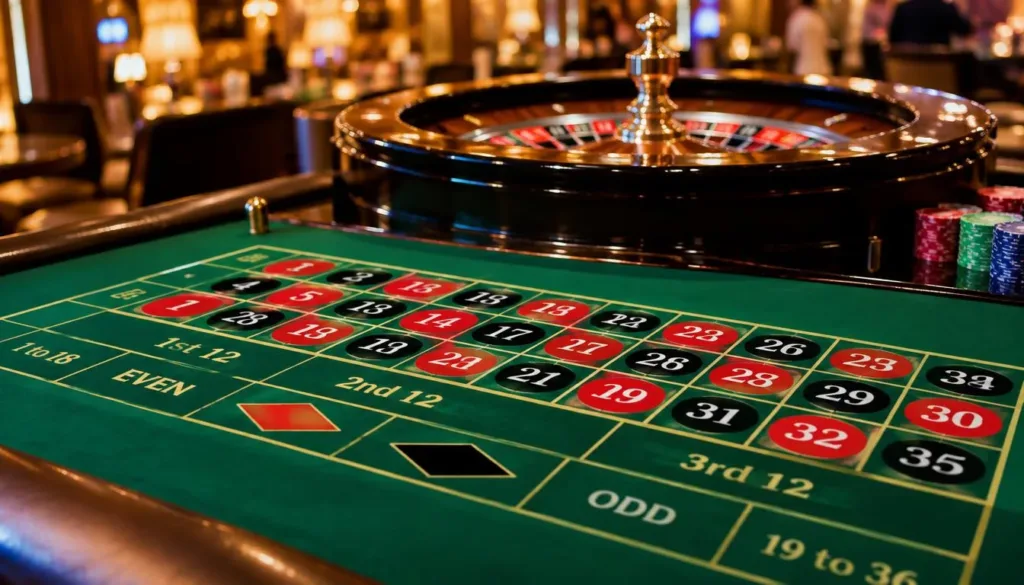
Inside Bets
Inside bets sit on the numbered grid, and six of them are standard. Straight: one number, paying 35:1. Split: two adjoining numbers, paying 17:1. Street: a row of three, paying 11:1.
Corner: four numbers meeting at a point, paying 8:1. Trio: zero with two of its neighbours, 0-1-2 or 0-2-3, on the single-zero layout. Basket: the zero and the first row together, five numbers on an American layout. Trio and basket are the two a beginner can ignore.
The swing on inside bets is the point. A straight-up hits about once in 37 spins on a European wheel, so a run of 60 or 70 misses is ordinary. Betting on single numbers is a long wait for a big payout, not a worse deal.
Outside Bets
Outside bets sit around the grid, and six are standard. Red/black, odd/even and 1-18/19-36 pay 1:1. Dozens (1-12, 13-24, 25-36) and the three columns pay 2:1.
Outside bets are the beginner’s usual choice because they win often. A 48.65% chance lands close to every other spin, which keeps a small bankroll alive long enough to learn the pace. The dozens win about one spin in three and double the stake, a middle ground between red and a straight number.
The detail most guides skip: every bet on the same wheel carries the same house edge. The straight-up bet is not worse value than red, it is only more volatile. The table pays 35:1 for a 1-in-37 shot and 1:1 for an 18-in-37 shot, and both shortfalls come to the same 2.7%.
A £1 chip on red loses about 2.7p per spin on average, and a £1 chip on 17 loses the same 2.7p. The difference is that the red chip loses it in small steps while the straight-up chip loses it in long droughts. Choose by the swing you can stomach, not by the payout, because the payout already prices in the chance.
How 20p Roulette Demos Work
A 20p roulette demo is the same single-zero game with play-money chips, and at a UK-licensed site you will be asked to prove your age before it loads. The demo runs the same game logic and paytable as the cash version. What changes is the balance, which refills and buys nothing.
20p Roulette itself is a single-zero RNG game long found on UK betting-shop terminals and in the casino tabs of sports betting sites. It is named for its 20p minimum stake. Players who play online today meet the same layout the shop terminal showed.
Low-Stake RNG Roulette Titles
20p Roulette offers the cheapest route onto a standard 37-pocket wheel, but it is not alone. 1p Roulette, 100/1 Roulette, Lightning Roulette, First Person Roulette and NetEnt American Roulette are other RNG titles common in UK lobbies. Most licensed sites carry a demo of each.
100/1 Roulette adds extra pockets paying 100:1, which changes the odds from a standard 37-pocket layout. Lightning Roulette adds multipliers, and NetEnt American Roulette runs the double-zero wheel. Online roulette games with a twist are never priced like the plain version, so read the help screen before the demo.
Free Play and Age Checks
A demo shows you three things: the layout, the bet types and the pace. It cannot show the fourth, which is your own reaction to losing real money. Play-money losses do not sting, and a plan that feels fine on free credits feels different at 20p a chip.
Since May 2019 UK-licensed operators have had to verify a customer’s age before giving access to free-to-play versions of casino games. Expect to register before any roulette game loads in free mode. A demo that is open to anyone with no age check is almost always on an unlicensed site.
A free online “roulette wheel” spinner that returns 1-36 plus two zeros is a number picker, not a casino demo. It tells you nothing about any real game. Only a demo inside a licensed lobby mirrors a title you can later stake on.
Our routine for a demo is short. Play 50 spins on even-money bets, then 50 on dozens, and note the swings in the balance after each block. Treat the demo as a reading of the layout and the pace, not as a test of a system, because 100 free spins prove nothing about the next 100 paid ones.
RNG Blackjack, Baccarat and Other Table Games
Yes, RNG tables usually offer better odds than slots: blackjack to basic strategy gives up about 0.5% and the baccarat banker bet about 1.06%, while a typical online slot keeps 3-8%. Most online slots return about 92-97% of stakes. Roulette tables on a single-zero wheel sit between the two groups.
The same certified generator deals the cards as picks the roulette pocket. A blackjack shoe in an RNG game is a mapped random stream, exactly like a wheel. The casino games differ in their maths, not in the randomness underneath.
| Game | Typical house edge | What moves it |
|---|---|---|
| Blackjack (basic strategy) | About 0.5% | Player decisions and the rule set |
| Baccarat banker bet | About 1.06% | Nothing, the draw rules are fixed |
| Three Card Poker (ante) | Roughly 3.4% | Side bets added to the ante |
| Online slots | About 3-8% | The title’s set RTP |
Blackjack and video poker are the only common RNG table games where the player’s decisions change the edge. Basic strategy is a fixed chart of hits, stands, doubles and splits for every hand against every dealer card. Follow it and the game keeps about 0.5%.
The exception generic articles miss: blackjack’s low edge exists only with basic strategy. A player guessing hits and stands can push the edge above a slot’s, because every wrong decision hands the casino a slice of the hand. The table is only cheap for the player who has learned the chart.
Baccarat asks for no decisions beyond the bet, which is why the banker figure holds for everyone. Three Card Poker keeps roughly 3.4% on the ante with correct play, already above single-zero roulette. Most other RNG table variants add complexity without lowering the edge.
Side bets on any table game typically carry an edge several times the main bet. A side wager beside a 0.5% blackjack hand throws away the advantage the strategy chart earned. Skip the side bets on every table, since they are where a low-edge game quietly turns into a high-edge one.
UK Online Casino Rules in Force for 2026
Every RNG roulette spin at a UK-licensed site now takes at least 5 seconds, there is no autoplay, and the screen shows your net spend and session time as you play. Four rules came into force on 17 January 2025 and still define what an online casino game may do in 2026. A missing button is compliance, not a fault.
The rules apply to every online casino product, from roulette to blackjack to slots. Live dealer tables are covered too, though their pace already satisfies the speed limit by nature.
Spin Speed, Autoplay and Multi-Table Limits
Three of the four rules shape the game itself. Each one removes a feature that used to be standard in RNG lobbies.
- Spin speed: online casino games must not have spin speeds of less than 5 seconds, with peer-to-peer poker the only exception.
- Autoplay: operators must not offer autoplay for online casino games, so every spin needs a press.
- Multiple products: operators must not offer functionality that facilitates playing multiple online products at the same time, including roulette and blackjack tables.
A live dealer wheel takes longer than 5 seconds to spin once bets have closed, so the speed rule changes nothing at the studio. On RNG tables it ends the turbo spin. Fifty spins now take a little over four minutes, which is the point.
The detail generic guides miss: a UK site that still offers autoplay on roulette, or lets you open two tables at once, is either breaching its licence or not holding one. Both are reasons to leave. Players sometimes read the missing autoplay as a broken game, and it is the opposite.
Net Spend and Time on Screen
The fourth rule puts money and minutes on screen. From 17 January 2025 operators must show customers their net spend and the time they have spent gambling in real time. The figure updates after every settled bet.
Reading it mid-session is simple. Net spend is what you have staked minus what has come back, so a player who sees it at £12 is down £12 whatever the last five spins did. The time counter is the one players ignore, and a session that felt short often reads far longer.
One figure does not apply to roulette. Online slot stakes at UK-licensed sites are capped at £5 per spin for players aged 25 and over and £2 for those aged 18-24, introduced in 2025, and these caps apply to slots rather than roulette tables. Do not expect a cap on a roulette chip.
We glance at both figures every ten spins. Use the net spend figure as your stop line, because it already counts every win and loss since you logged in.
Myths About Online Roulette Results
Eight reds in a row make the ninth spin exactly as likely to land red as the first one did. Roulette spins are independent: previous results do not make a particular result more or less likely on the next spin. Every spin starts from nothing.
Five beliefs cost online roulette players more than any bad wheel. Each sounds like observation, and each is wrong.
- A colour is due after a run: it is not, because the wheel has no memory and the odds reset on every spin.
- Hot numbers keep hitting: hot and cold numbers do not exist, but recency bias does, and it makes recent hits feel significant.
- The live wheel can be read: watching live wheels creates no measurable edge, and live dealer roulette settles at the same rate as software.
- RNG is less fair than live: at licensed casinos the generator is audited, so RNG games are no less fair than live games.
- The animation decides the result: the pocket is chosen before the ball moves, and the graphics only report it.
The result history panel is the myth factory. It is a legal display feature, not a prediction tool, and the Gambling Commission requires it to be accurate rather than useful. A strip of twenty past numbers tells you what happened, never what comes next.
Players who call live roulette fairer, or online roulette rigged, are usually reacting to the same strip. Our habit is to hide the panel where the game allows it, because a blank screen tempts nobody. The only pattern that exists in roulette is the house edge, and it shows up over thousands of spins rather than in tonight’s ten.
Roulette Betting Systems and Why They Fail
Every betting system rearranges when you lose, not whether you lose, because each stake it places still faces the same house edge. The sound roulette strategy for beginners is to bet a flat stake on even-money bets at a single-zero wheel, about 1-2% of the session bankroll, with a stop-loss fixed before the first spin. Nothing more elaborate improves the return.
Five strategies dominate the forums, and five fail the same way. The mechanic differs; the arithmetic does not.
- Martingale: double the stake after every loss, so one win recovers the run plus the first stake. It fails when the next double exceeds the table maximum or the bankroll.
- Fibonacci: raise stakes along the sequence 1, 1, 2, 3, 5, 8 after losses. It climbs slower than Martingale and still reaches the ceiling on a long losing run.
- D’Alembert: add one unit after a loss and remove one after a win. It feels gentle and bleeds the edge on every stake, since wins never outnumber losses over time.
- Paroli: a positive progression that raises stakes after wins. It fails because a single loss at the top of the ladder returns the whole run.
- Flat betting: keep the stake constant. It fails to beat the edge too, but it is the only one whose worst session is known before it starts.
The Martingale arithmetic is worth writing out. A £1 start needs a £256 stake after eight straight losses and £511 of total exposure to win back £1. Eight losses in a row on an even-money bet is not rare across a long session; it is expected.
A table maximum, not bad luck, is what ends every Martingale sequence. RNG tables with low minimums reach that ceiling in fewer doubles than players expect, because a 20p table rarely carries a high maximum. The player hits the wall while the system still owes money.
No system changes the house edge, because every bet on the same wheel carries the same percentage. Staking plans change the shape of the loss, bunching it into one bad run or spreading it thin. The average remains the edge multiplied by total stakes.
If a system needs more money than you have brought to the session to complete its sequence, it has already failed before the first spin.
Safer Play, Losses and Where to Get Help
Our rule for RNG roulette is a deposit limit set before log-in and never raised in the same session. The reason is timing: a deposit limit set after a loss takes effect at once, while a request to raise a limit at UK-licensed sites waits 24 hours. Set it before the session, not during, and the waiting period works for you.
The scale of harm is not abstract. GamCare’s Money Guidance Service supported 1,954 people after gambling losses in 2025, compared with 923 in 2024, an increase of 112%. Those people reported more than £7.2 million of collective debt, averaging £21,269 per person who disclosed debt.
Net deposits above £150 a month trigger a light-touch financial vulnerability check at an online casino: the operator looks at data it already holds, and nobody asks for a payslip.
That check has run since 28 February 2025, and most players never notice it. Every UK-licensed casino must offer the tools below in the account settings, and we set three of them before the first spin.
- Deposit limit: a daily, weekly or monthly cap on money in, the single most useful tool for playing online.
- Time limit: a cap on session length, with the game closing when it is reached.
- Reality check: a reminder at a set interval showing time played and the running result.
- Cooling-off: a short break from the account during which the site stays locked.
- GamStop self-exclusion: one registration blocks every UK-licensed casino and sports betting site at once.
Online casinos are 18+ only, and GamStop is the route when play stops being a priced form of entertainment. The scheme works at account level rather than game level, so it covers RNG and live tables alike. A player who signs up cannot undo it on a whim the same evening.
Loss is the thing to watch, not luck. A session where the balance falls faster than the plan allowed is the moment to close the tab, and the reality check exists to make that moment visible. The National Gambling Helpline on 0808 8020 133 answers 24 hours a day, 365 days a year, and the call is free.
Conclusion
Two choices decide almost everything in online roulette: a Gambling Commission-licensed site and a single-zero wheel. Fairness is settled by the licence and the test house, and value is settled by the number of zeros on the wheel. Every other decision, format, bet type or stake size, moves the experience rather than the return.
The next step takes an evening. Open a 20p demo on a single-zero game, complete the age check, and set a deposit limit before switching to cash play. Players who do those three things in that order meet the casino on the terms the RNG games were certified under.
Play 18+ only, keep GamStop in mind if the game stops being fun, and let the house edge, not a hunch, set your expectations.
FAQ
Is roulette pure chance?
Yes, roulette is pure chance: every spin is an independent random result with no skill element. The only choices that change your long-run return are the wheel type and the stake size, and neither affects the next number. Skill shows only in bankroll discipline, which decides how long the money lasts, not whether a given spin wins.
How do I know if my online casino is rigged?
Search the licence number on the Gambling Commission register, find the test-house seal and the named provider in the lobby, and check that the game help screen shows its RTP. At a licensed site a losing run is variance, not manipulation. Keep a written log of 200 spins if you want your own evidence: the red and black counts will sit near 48.65% each, give or take normal noise.
What is the most winnable game at a casino?
Blackjack played to basic strategy, with a house edge under 1%, is the most winnable common game, followed by the baccarat banker bet and single-zero roulette. The edge rises sharply when a player ignores basic strategy or takes side bets. Winnable means the cheapest to play per hour, not a game you can beat over time, because every one of them keeps a margin.
What is the smartest bet at a casino?
An even-money bet on a French wheel with La Partage, where the edge drops to 1.35%, or a basic-strategy blackjack hand. The worst common bets are American roulette and any side bet. French tables are rarer than European ones in UK RNG lobbies, so a plain single-zero even-money bet at 2.7% is the usual best bet available on a given night.
How to win big in casinos?
No method raises your expected return above the house edge. Large wins come from variance on high-payout bets such as a 35:1 straight-up, where a £5 chip returns £175 profit on a hit that lands about once in 37 spins. Set a loss limit first and treat a big win as the moment to stop, because the edge resumes on the very next spin.
Can I play a 20p roulette demo in the UK without an account?
Not at a UK-licensed site, which must verify age before any free-to-play casino game loads, so registration comes first. A demo open to anyone with no check is a sign of an unlicensed site. Registration usually takes a few minutes, and once the age check clears, the demo and the cash version sit side by side in the same lobby.
Do I pay tax on online roulette winnings in the UK?
No, UK players keep winnings tax-free because the duty is charged to the licensed operator, and this applies to RNG and live dealer games alike. A £1,000 straight-up win arrives in full, with nothing to declare to HMRC. The same rule holds for sports betting and slots at a licensed site, whatever the size of the win.